Columbia College c/o 2021, Economics-Political Science
Visual media
Musical pairing: Beethoven’s Fifth Symphony, Fourth Movement (in this video, 26:30 is a good start)
I selected the visual piece of a building being constructed to mirror the composition of Beethoven’s most famous symphony. The construction of the skyscraper brings it steadily upward, just as E.T.A. Hoffmann describes a composition that “in a climax that climbs on and on, leads the listener imperiously forward into the spirit world of the infinite!”
And also like this building, the symphony is carefully constructed from a large series of similar, but not identical, base components that create varying levels of complexity and ultimately build the entire piece.
I chose this clip of Snow White singing to a group of doves because I thought the song “Mozart Le Nozze Di Figaro, K-492 – Act 2: Voi Che Sapete” closely related to the piece. The tranquility of her voice sounded like Snow White could have sang it herself, because her character is a peaceful and thoughtful person. I thought it was fitting that since the musical piece is about love, that I would have the scene where Snow White finds the Prince and ultimately falls in love. It was a very melodic piece with lots of text-painting which I enjoy when the words match the sound.
The first thing that came to my mind when listening to Hadyn’s Symphony No. 94 was silly gags from childhood cartons—specifically, the ironic ones that involve some large explosion at the antagonist’s expense. “Surprise” makes use of dynamic range to really surprise the listener with a sudden crescendo that unexpectedly comes amidst a uniform and rather boring repetition of the same phrase. Similarly, Wile E. Coyote is performing an innocuous thing (in its mind) before unexpectedly blowing up! It’s an ironic sequence, as the viewers clearly know what’s going to happen; for listeners who had already heard “Surprise” before, I imagine they might have messed with their friends by bringing them to hear Hadyn play it.
While listening to this piece, which is in ternary form, I pictured the plot of a Disney movie. The A sections made up most of the story and were lighter, focusing on the hero in a major key. Meanwhile, the B section transitioned into a minor key with richer instrumentation, which I associated with a villain, since villains often are more interesting and complicated. Particularly, the dynamics of the B section reminded me of this scene with Ursula, as she goes between loud, dramatic singing to making snide comments and tricking Ariel. The repeated motifs in both sections reflected how something light and promising in the A section, or being a human for Ariel, can be just as deceiving and dark in the B section, or used to take over the world by Ursula.
I think that this scene represents the qualities of fugue both generally and in this piece in particular. The mood in the room starts out calm, as Lucy and Ethel are drawn into a state of false security based on the initial amount of chocolate coming along the conveyor belt, just as the music starts out simple. As time passes, the conveyor belt picks up speed, which complicates the process by having to keep up with more chocolate, just as the listener must keep up with multiple musical lines. Additionally, although each seems complicated, both pieces find resolution in the end.
When I listened to the chorus of Handel’s Messiah, the first thing that caught my attention was the air of grandeur and splendor created by the music. This sense of majesty is largely attributable to the climaxes of intensity and range found in the chorus. The chorus forms a wave-like contour in terms of pitch and volume—as there are sharp peaks of intensity and pitch on the first syllable of “Hal-le-lu-jah.” Later in the chorus, this emphasis shifts to the syllable “lu”—but the effect remains the same. These peaks and troughs of intensity lead to a melody “rich in expression that rises and falls in great majestic arches” (Forney and Machlis 126).
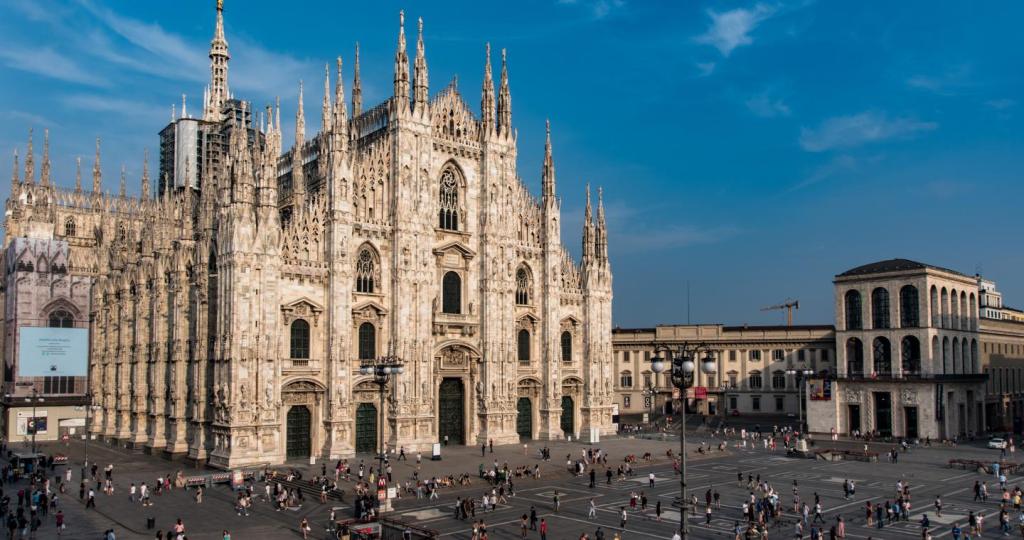
The first image that came to my mind after
hearing the piece was the Duomo of Milan (Milan’s cathedral), because it
perfectly captures the sense of grandeur and height/elevation achieved by the
music. The façade’s most notable feature
is a series of 10 spires—with the spires increasing in height as one moves towards
the center of the façade. These spires—and
the gaps between them— create a sense of magnificence and verticality that
mimic the peaks of intensity and range that are found in the Chorus of Handel’s
Messiah. In effect, both pieces—the Duomo
and Handel’s Messiah—use their “height” to reach towards the heavens, a common
theme shared by religious music and religious visual media.
William Cagle, Creative Writing and Cultural Anthropology, 2020
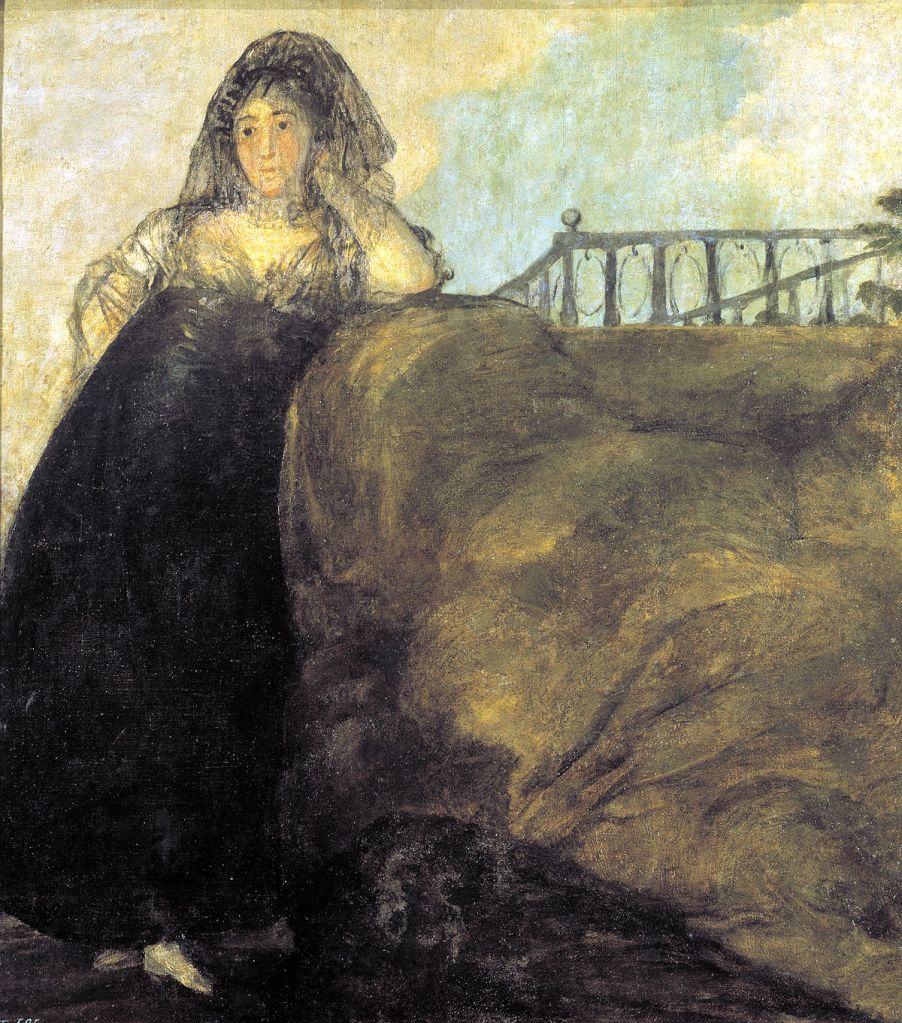
“When I am laid in earth,” Henry Purcell (1689)“La Leocadia,” Francisco Goya (~1820)
This portrait is one of Goya’s “Black Paintings,” created in his later years when his health was failing and his eyesight had greatly diminished, depicting his maid and suspected lover mourning over his impending death. I wanted to pick a portrait for early opera, as it so prominently features the soloist. In this portrait, Goya makes use of a very somber, subtle color palette which feels “minor,” and matches the mournful melody and quiet orchestration of Purcell’s aria. In the painting, as in the song, we see an isolated woman in mourning, to draw an easy connection between Dido and Leocadia. Opera moves toward a more defined form of musical storytelling than we’ve seen before, and so it seemed fitting to push us toward portraiture and away from the beautiful abstraction of murmurations and northern lights. But this painting is very simple and unembellished, which matches the unadorned melody of “When I am laid in earth.”
Aroosa Cheema, Political Science and History, 2021
I chose the painting “Drowning Girl” by the American pop-artist Roy Lichtenstein as my visual piece. While listening to Monteverdi’s “Ah, Dolente, patrita!” I was struck by the emotion and drama (verging on melodrama) of the piece, and that same melodrama and subject matter of separation is present in the painting. In addition, Lichtenstein’s pop art gave text a prominent position on the canvas just as the word painting of the madrigal directed the audience’s focus towards the actual lyrics being sung. The song has a large dynamic range with both high and low voices dominating the song at different moments, and that range is represented by the sharp contrast between white and black and the gradations of gray in the piece. Finally, the crashing waves in the painting mirror the individual singing voices in that they are part of a cohesive whole but are also distinct and dynamic in their positions relative to each other.
In the latest Star Wars film, Princess Leia is blasted off her ship and gathers the strength to pull herself towards safety. This scene reminds me a lot of Palestrina, Missa Papae Marcelli, “Gloria” for a few reasons. Firstly, when listening to the song, it maintains a relaxed feel, even though the melody is full of climaxes aiming to reach the heavens. So too, in this scene, when the audience thinks Leia’s life will soon end, she calmly collects herself and connects to the force. She is able to propel herself in the most delicate manner towards safety. In the song Gloria, the songs climactic melody tells a tale of reaching a heavenly place all while being very soothing and relaxing. In addition, the airy feel, and heavenly lyrics of Gloria, remind me of outer space, which is where the Star Wars scene takes place. Lastly, the song expresses a unified cohesion of different singers working seamlessly towards the same goal. So too, in perfect form, Leia’s every body part and soul are united, and you and see it when she closes her eyes, her fingers unite, (signifying her body’s connection to the force) and she propels her forward in perfect alignment.
Ultimately, no matter how many explanations I give, if you mute the Star Wars Film, and play Gloria in the background, and hit play, you will feel an indescribable connection that makes these different art works come together.
This piece is a time-lapse of different viewings of the northern lights.
I believe the northern lights time-lapses are a good visual complement to Palestrina’s Gloria due to both pieces being dynamic. Gloria contains moments that are quieter and moments that are louder. Additionally, the texture varies through out the piece. The time-lapse is also very dynamic due to the movement of the light. Additionally, the contrast between the light and darkness in the northern lights emulates the contrast in Gloria between low and high register voices.
Finally, Gloria is created by different human voices working together, and the northern lights are caused by different natural forces happening in conjunction. The various shades and colors of the northern lights captures the essence of different voices working in harmony together. The colors combined with the movement of the lights is able to show, in a visual way, the energy and positivity that is felt by listening to Gloria.

 Levitsky Music Hum Fall 2019 Class Blog