Alongside Sonata V by John Cage, I have chosen Yves Tumor’s music video for their song “Licking an Orchid.” Sonata V, due to its eerie and strange sound, has a sort of suspenseful nature to it. And in thinking of this suspense, I look to the work’s lack of a clear meter as perhaps a reason why it might be perceived as suspenseful—one is always anticipating the next note, sound, phrase. Similarly, Yves Tumor’s video conveys a sense of chaos and rupture with the music itself, albeit, this “chaos” at certain moments sounds and is visualized as a sort of controlled chaos. Particular frames in the video capture such feelings of frenzy, anger, intimacy, repulsion, etc. and these emotions are shown through a kind of see-saw effect, in that the artist’s experience extremes (i.e. anger, intimacy) all in mere seconds, so that the viewer does not really know what to expect in the next frame, or even in the next few seconds. When listening to Sonata V, I felt this see-saw effect, this controlled chaos, for it felt chaotic or disjunct, but at the same time it was also contained within its ( irregular) phrases that constituted the piece as a whole. Thus, despite these feelings of chaos or suspense, the piece itself is still organized, although its organization is rendered as disorganization.
Heven Haile, American Studies, CC’21
Composer: Billy Strayhorn & Duke Ellington
Year: 1939
Beyoncé
During the Harlem Renaissance, Jazz was used as a tool to display Black extravagance, since African-Americans were deemed to be devoid of culture. The “A train” was the quickest way to get to Sugar Hill, which is where Black Harlem royalty lived. In our contemporary time, Beyoncé is apart of the cultural elite. In “Get Me Bodied,” she and her exclusive clique display their opulence. Jazz is also a communal enterprise. The lines between the audience and the performers are very blurred. The community comes together to carve meaning and forge a sense of belonging amidst the chaos and confusion of their lives.
Omozusi Inegbeniki, Poli Sci, CC22
Date: 1932
Genre: Jazz
Composer: Duke Ellington
Lyricist: Irving Mills
Visual Piece
Scene: Hairspray Movie (2007)
Song: Run and Tell That
Hairspray
- Both the song and the scene emphasises the importance of using dance as a form of expression and alternative protest to the suppression of African American dance and music. The fast movements of jazz/twist influenced dancing and the pace of the swung jazz beat. I chose this particular scene to reflect how Duke Ellington’s music was often prey to the white gaze and whilst this built appreciation and attraction to jazz it later also brought music appropriation and theft.
- The song has a syncopated rhythm, making the weak beats become stronger and vice versa. This gives the piece an all-round danceable feeling.
- Movie: Set in 1960s Baltimore
- This particular song “Run and Tell that” is a fun and upbeat song yet, its underlying message protests againt discrimination
- Starts with the lyrics “I can’t see why people look at me and only see the color of my face”
Jaime Gonzalez, MLS/Pre-Med, CC ’21
The opening notes of Aaron Copland’s Appalachian Spring sound like an awakening to a folklike morning filled with spiritual rituals and feasts. It’s largely unmistakeable to a niche aesthetic lifestyle of flower crowns and simple living. I recall a scene from Midsommar (2019) that opens up more to the scenery and setting of the film that I feel is important with the music in how it functions with the setting it is in.
Irene Koo, Psychology, GS’19 – La Boheme
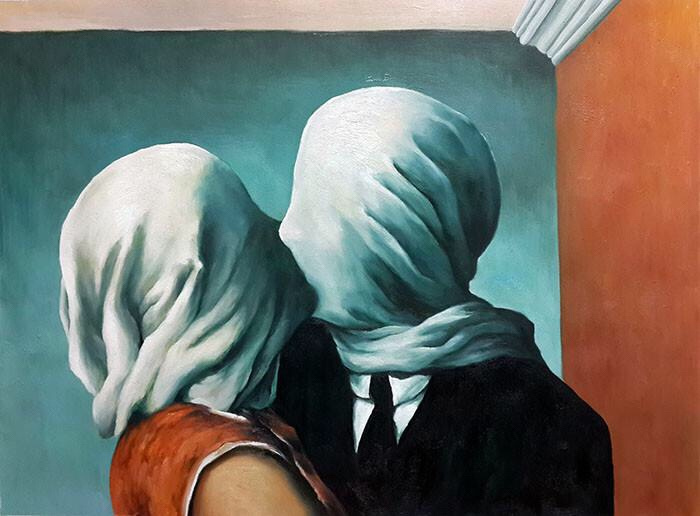
Magritte’s The Lovers may seem too restrictive and unemotional to be seen in comparison to the Sono Andati? in La Boheme, considering that it is the piece when Mimi is gradually dying. However, in Sono Andati?, Mimi and Rodolfo do not mention anything about death but only recall their first encounter and their happy moments, putting their real emotions aside. Concealing their actual sentiment resembled the lovers in Magritte’s painting where they hide their facial expressions but nevertheless show their emotions with their acts of embracing each other.
Niko Motta Financial Econ. CC ’22 – The Second Viennese School
Webern’s Symphony Op. 21 is a beautifully ominous composition that I felt set well with this particular scene from an episode of Luther. The scene, like Webern’s piece, is marked by a strong sense of tension which breeds suspense and slight discomfort. Additionally, the environment supports the tension within the scene a comparable amount to the perpetrator himself, just as an array of instruments seamlessly interchange equal roles in the melody of Webern’s piece.
Lauren Alcindor English/Linguistics, CC ’21
I paired “Almost There” from Princess and the Frog with William Grant Still’s “Afro-American Symphony” because the two share a number of similarities. Firstly, similar time periods: Princess and the Frog is set in the mid 1920’s, and Still’s symphony was completed in 1930. Also, Still wrote the first symphony to feature the banjo and this movie also showcases the banjo throughout the score. Lastly, both works emphasize hope for African-Americans. The song “Almost There” is about the protagonist’s dream of running a restaurant. It’s idealistic in the same way Part III of the symphony feels optimistic.
Stravinsky’s Le Sacre du Printemps
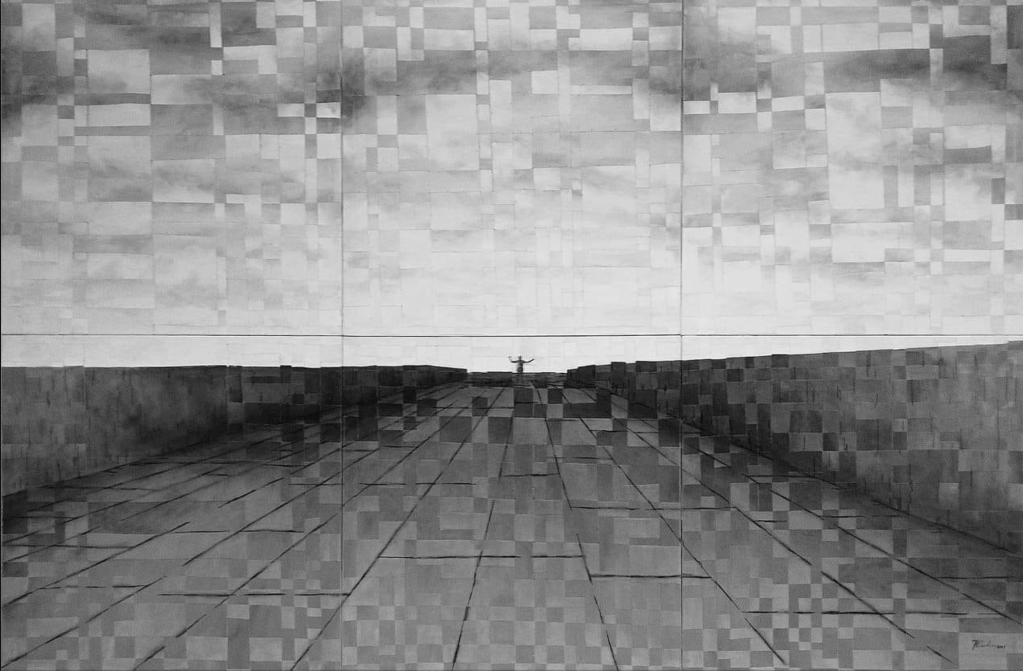
Carolino’s O mundo fez-se grande and Stravinsky’s Le Sacre du Printemps both portray what one expects to be pleasant themes — the opening up of the world and the coming of spring — unpleasantly. The painting and song to me feel somber, uneasy and aggressive. Carolino’s painting is made out of six canvases glued to each other, which have stripes of canvas sown on top of them to create texture. This, to me, creates fragmentation, unpredictability and discontinuity in color, which matches the unpredictability, dissonances and rhythmic conflicts we experience in Le Sacre du Printemps.
Carolina Lacs, Psychology, Class of 2021
Charles Debussy – Voiles (Préludes – Book I) (1909)
“By using the word ‘nocturne’ I wished to indicate an artistic interest alone, divesting the picture of any outside anecdotal interest… A nocturne is an arrangement of line, form and colour first.”
(J.A.M. Whistler, quoted in Dorment and MacDonald, p.122)
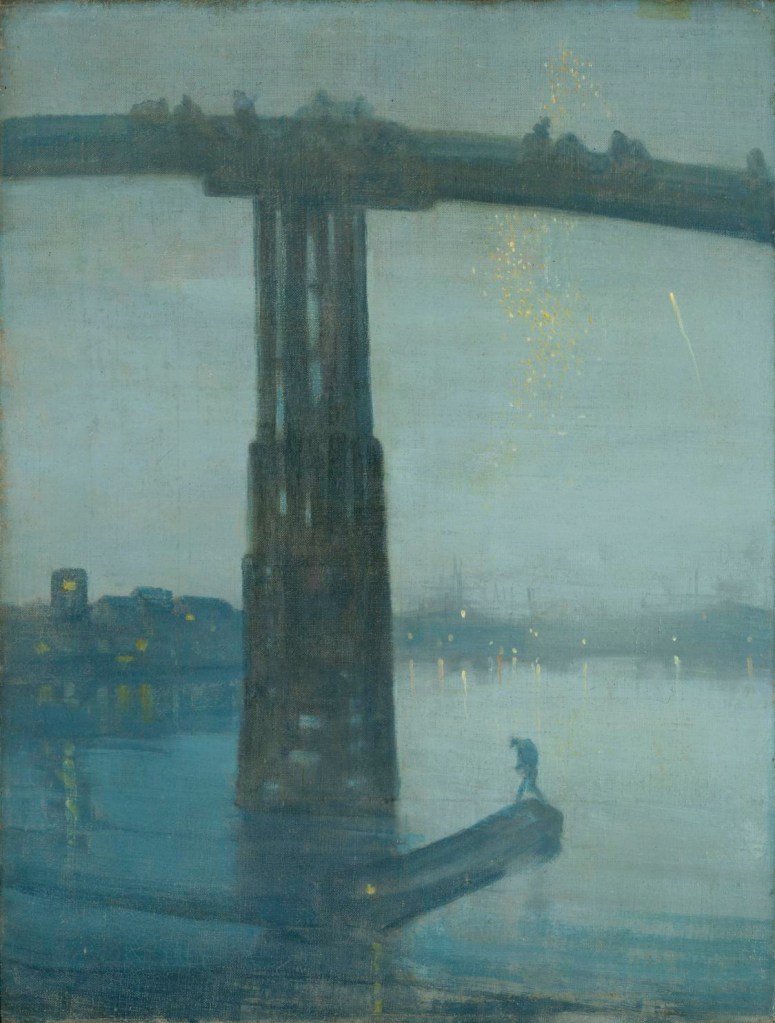
Whistler’s Nocturne: Blue and Gold – Old Battersea Bridge for me mirrors many of the emotions of Debussy’s Voiles: Préludes – Book I. Both have a creeping sense of isolation and displacement. Whistler’s lone figure on a jetty hangs silhouetted before a mirror of the sky, with no clear destination – suspended in space and time. It could be night, it could be morning; a city waking among the debris of its last revelers or lighting up for a night of modern entertainment. Similarly, Voiles loops perfectly, its meanderings mapping no clear path or trajectory, a sensory experience suspended – a rejection of narrative and chronology, of music as a translation of story. These suspensions exacerbate the profound sense of distance found in both pieces. Whistler’s distant quay and buildings are foggy, the length of the bridge is unsettling in its unmoored height, and the painting’s bottom edge ends in murky water, leaving the viewer with no foreground within which to stabilize their observation. Profound gaps of negative, or flattened, space intersperse the painting, creating an intensely geometrically fragmented landscape. In a similar sense, Debussy’s Voiles revels in gaps and silences, echoing reverberations and sudden crescendoes just as quickly left adrift, isolated and fragmented. Both pieces also show a flair for the alienated, the mechanized natural, the transient – standard tropes of modernism emerging across the arts at this time period within increasingly industrialized cities at the turn of the century.
“I did not intend to paint a portrait of the bridge… My whole scheme was only to bring about a certain harmony of colour.”
(J.A.M. Whistler, quoted in Dorment and MacDonald, p.131).
Jay Castro, History and American Studies double major, CC ‘ 20.
Schubert, “Erlkönig” Presentation
Tess Kim, CC 2021, History major
In order to reflect the eerie and intense atmosphere of the song, I chose a scene from Corpse Bride. In this scene, Victor (the male protagonist) runs away after seeing his corpse bride for the first time. The fast repeats of the piano motive in minor key accompany Victor’s panicked running in this scene. In contrast to Victor’s horrified panic, Emily (the corpse bride) tries to entice him with her soft voice- reflecting the Elfking’s melodic voice in the major key. This scene from Corpse Bride captured both the Romantic era’s dark fascination with “strangeness and wonder” and the eeriness of the Piano motive.
 Levitsky Music Hum Fall 2019 Class Blog