“By using the word ‘nocturne’ I wished to indicate an artistic interest alone, divesting the picture of any outside anecdotal interest… A nocturne is an arrangement of line, form and colour first.”
(J.A.M. Whistler, quoted in Dorment and MacDonald, p.122)
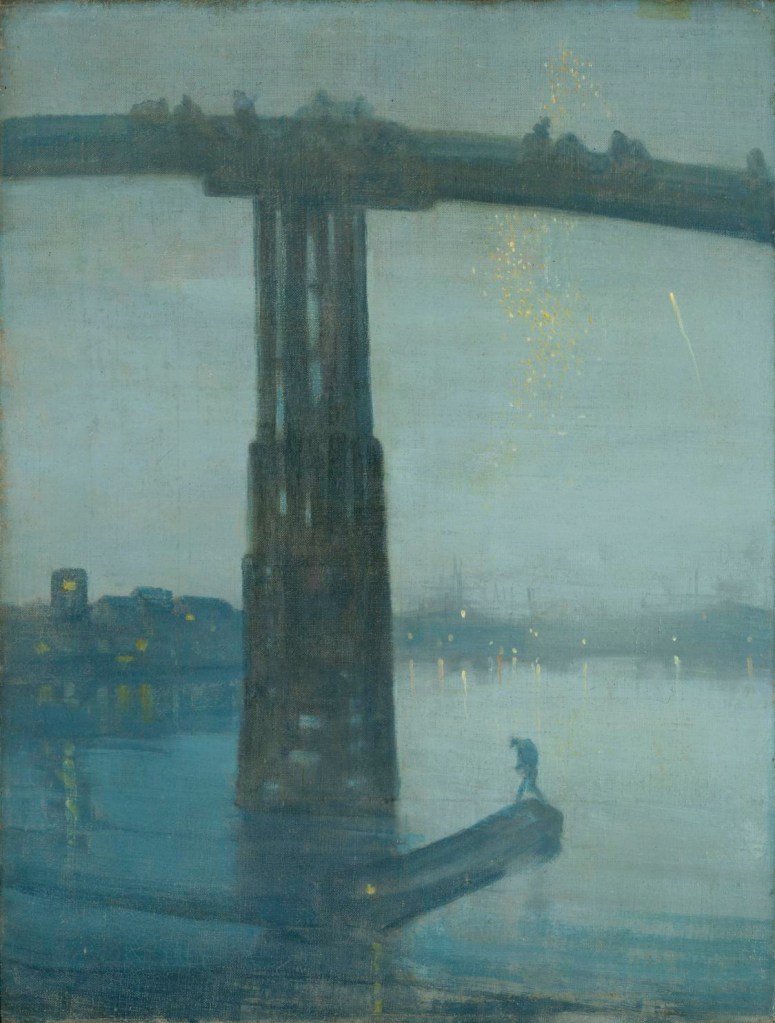
Whistler’s Nocturne: Blue and Gold – Old Battersea Bridge for me mirrors many of the emotions of Debussy’s Voiles: Préludes – Book I. Both have a creeping sense of isolation and displacement. Whistler’s lone figure on a jetty hangs silhouetted before a mirror of the sky, with no clear destination – suspended in space and time. It could be night, it could be morning; a city waking among the debris of its last revelers or lighting up for a night of modern entertainment. Similarly, Voiles loops perfectly, its meanderings mapping no clear path or trajectory, a sensory experience suspended – a rejection of narrative and chronology, of music as a translation of story. These suspensions exacerbate the profound sense of distance found in both pieces. Whistler’s distant quay and buildings are foggy, the length of the bridge is unsettling in its unmoored height, and the painting’s bottom edge ends in murky water, leaving the viewer with no foreground within which to stabilize their observation. Profound gaps of negative, or flattened, space intersperse the painting, creating an intensely geometrically fragmented landscape. In a similar sense, Debussy’s Voiles revels in gaps and silences, echoing reverberations and sudden crescendoes just as quickly left adrift, isolated and fragmented. Both pieces also show a flair for the alienated, the mechanized natural, the transient – standard tropes of modernism emerging across the arts at this time period within increasingly industrialized cities at the turn of the century.
“I did not intend to paint a portrait of the bridge… My whole scheme was only to bring about a certain harmony of colour.”
(J.A.M. Whistler, quoted in Dorment and MacDonald, p.131).
Jay Castro, History and American Studies double major, CC ‘ 20.
 Levitsky Music Hum Fall 2019 Class Blog