The Polyphony of Starlings

Rose Liz, Printemps, Verdure by Guillaume Machaut

Douglas de Lancastre de Lima Mayer, GS, Senior with a major in Modern European History

Song: https://www.youtube.com/watch?v=8EWwQTJAK7c (not the same song as the one on canvas but very close)

Visual Media: https://www.youtube.com/watch?v=V4f_1_r80RY (without the sound)

“Starlings Murmuration” is a mysterious natural process in which birds flock together in a relatively compact and fluid formation. The formation isn’t stable, instead it’s composed of various groups of hundreds of starlings that wonderfully interweave and separate to create a unique ever-changing pattern. A true organized chaos!  

Similar to polyphony, “Starlings Murmuration” is the combination of different factions to create a harmonic whole. Much like the melodic lines of Rose Liz, Printemps, Verdure, the starlings complete each other to offer an incredible display of perfect synchrony. It is as if the creator of polyphony himself was inspired by the marvel of the starlings.
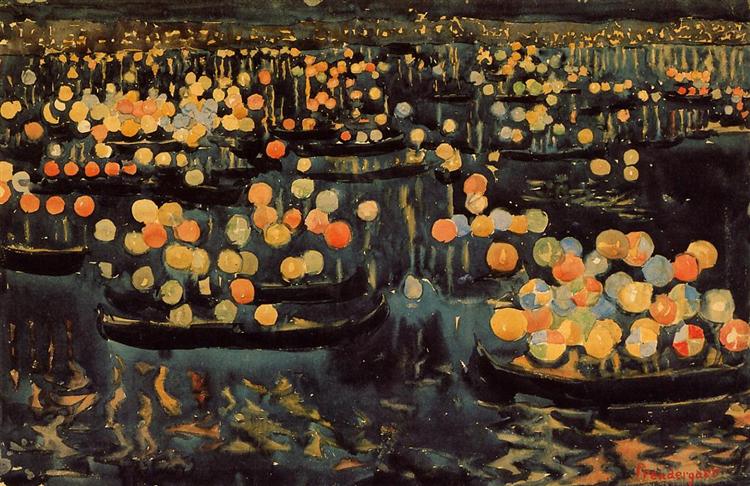
Reis Glorios, Guiraut de Bornelh // Feast of the Redeemer, Maurice Prendergast

Robert Willard, Slavic Studies and Economics, CC’20

I couldn’t upload the class version, but here is another excellent interpretation!

For some reason, I always find something meaningful in the works of Maurice Prendergast, a relatively obscure American post-Impressionist.

Reis Glorios is an alba, a dawn song; the music aptly transmits a feeling of warm, slowly breaking light. The version we listened to slowly layers in a rather modern-sounding polyphonic harmony which serves to augment this effect of dawn. The harmony brings out each instrument as a distinct line, as do the voices use differing techniques. Other versions of the song, which are less modernistic, still make use of such a layered quality that slowly evolves over each strophe.

Prendergast’s painting has a reminiscient warm light of dawn, that carries some secrecy and intimacy, reflected in the romantic quality of the song. As the music divides is divided between independent strophes, polyphonic lines and themes, the painting splits this warm light between distinct tones of color that combine into a cohesive whole.

Design a site like this with WordPress.com
Get started